What is a Beamline? Or as we call it, Beamtime!
In research, we cannot always buy or build the instruments we need in a local lab. For quantum materials Quantum Materials Any material that requires quantum mechanics or a quantum treatment to understand the macroscopic properties of said material. — Stolen shamelessly from my PI, Lucas Caretta , we require light of extreme brilliance, intensity, and tunable polarization. This leads us to massive particle accelerators known as Synchrotrons, where experimental halls are ringed by specialized research laboratories called Beamlines.
Anatomy of a Synchrotron
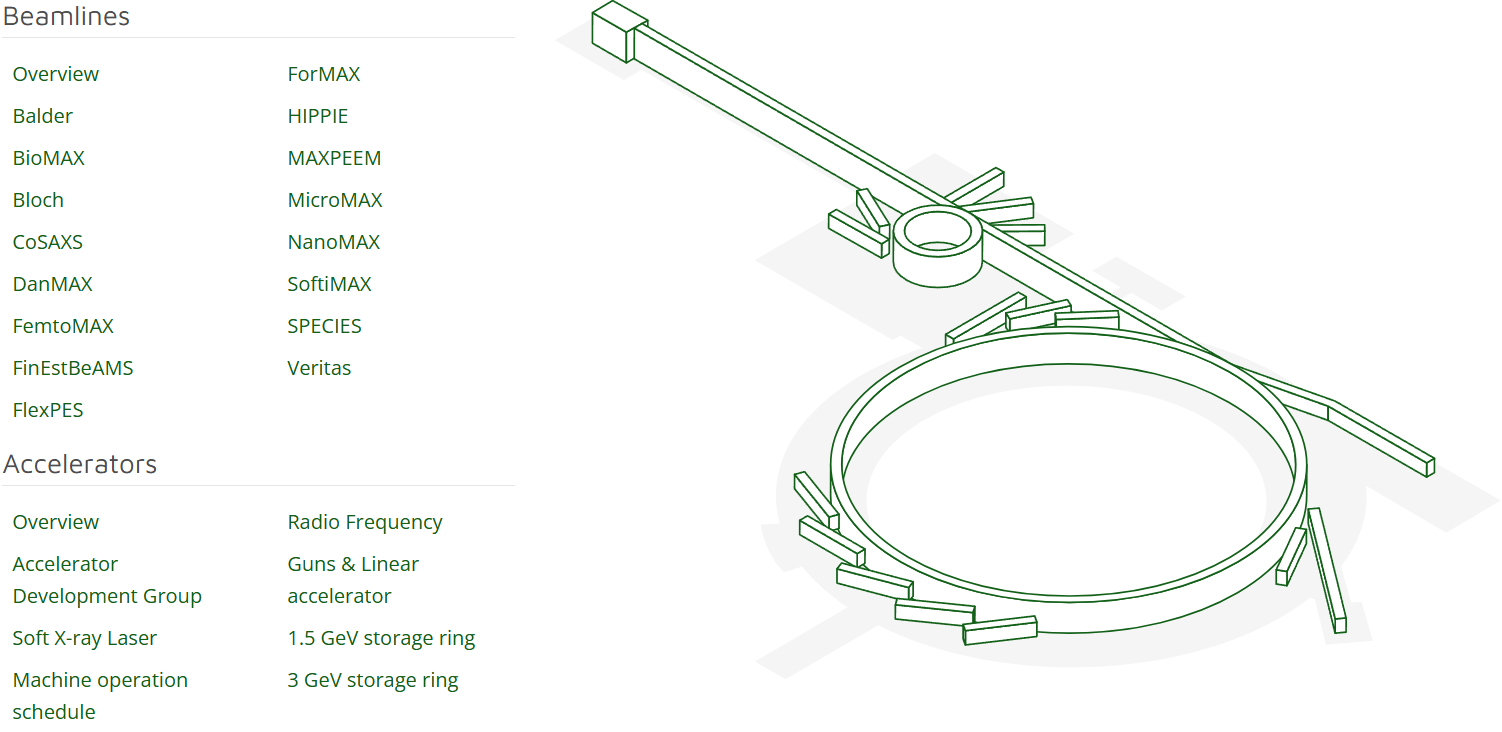 MAX IV Laboratory Layout — Swedish synchrotron facility. Check out their interactive Beamlines map.
How Synchrotron Light is Made
Synchrotron facilities accelerate electrons to nearly the speed of light. As these high-energy particles are bent through powerful magnetic fields, they release ultra-bright electromagnetic radiation spanning from infrared to hard X-rays. This synchrotron light is millions of times brighter than conventional laboratory X-ray tubes, allowing us to resolve nanoscale phenomena.
"If you don't happen to have an IBM 5100 handy to calculate the coordinates, don't worry. The physics is strictly governed by classical electrodynamics and relativistic physics, enabling sub-nanosecond research on physical materials."
LINAC
An electron gun ejects electrons, which are immediately accelerated through a Linear Accelerator (LINAC) to high energy levels.
Booster Ring
Electrons enter a circular booster synchrotron where electromagnetic pulses accelerate them to 99.9999% of the speed of light.
Storage Ring
Circulating electrons pass through bending magnets and insertion devices (undulators), forcing them to emit intense synchrotron light.
The Beamline
Optics huts focus the beam down to nanometers and experimental endstations use detectors to measure scattering and absorption.
My Beamtime Expeditions
I have been fortunate to perform beamtime experiments at several of the world's most advanced light sources, deploying spectroscopy and nanoscale imaging to probe multiferroic and antiferromagnetic materials.
MAX IV Laboratory
Coordinates: 55.727° N, 13.231° E
Worked extensively at the MAXPEEM endstation on the 1.5 GeV storage ring. Utilized X-ray Photoemission Electron Microscopy (PEEM) with circularly and linearly polarized soft X-rays (XMCD/XMLD) to map altermagnetic domains in multiferroic BiFeO₃ (BFO). MAX IV's setup is uniquely optimized for normal incidence measurements.
BESSY II
Coordinates: 52.428° N, 13.532° E
Conducted soft X-ray magnetic spectroscopy and microscopy experiments at Helmholtz-Zentrum Berlin. Utilized the UE49_PGM SPEEM endstation in Total Electron Yield (TEY) mode to investigate spin and orbital moments in engineered oxide heterostructures.
ESRF
Coordinates: 45.207° N, 5.689° E
Conducted experiments on Barium Tungstate (BaWO₃ / BWO) in fluorescence mode to investigate a potential Polar Metal at the Beamline ID12 endstation. The setup involved running an electrical current in a 4-wire sense configuration to verify if the metal remained polar under applied electric fields.
Advanced Light Source (ALS)
Coordinates: 37.876° N, 122.250° W
Conducted soft X-ray magnetic spectroscopy and PEEM imaging experiments looking for altermagnetism in multiferroic BiFeO₃ (BFO) at Lawrence Berkeley National Lab. The experiments utilized the 11.0.1.1 PEEM3 endstation. The ALS PEEM setup is uniquely characterized by its 30-degree oblique incidence angle.
Brookhaven National Laboratory
Coordinates: 40.870° N, 72.875° W
Utilized the National Synchrotron Light Source II (NSLS-II) looking for altermagnetism in multiferroic BiFeO₃ (BFO). Deployed the ESM-XPEEM (21-ID-2) endstation featuring its 16-degree grazing incidence, mapping magnetic textures at extreme low angles.
Looking for the science?
Read my scientific Write-ups, derivations, and interactive simulations covering X-PEEM and XMCD & XMLD theory.
Recall a Beamtime Memory
Access my experimental database logs. Fetch a random photo or video clip captured during my experimental beamtimes, geolocated in real time.
Click the button above to load a geocoded log from the database
Beamtime Memory Wall
Explore an ongoing stream of photos and geolocated snaps showing instruments, facilities, and the journey along the way.